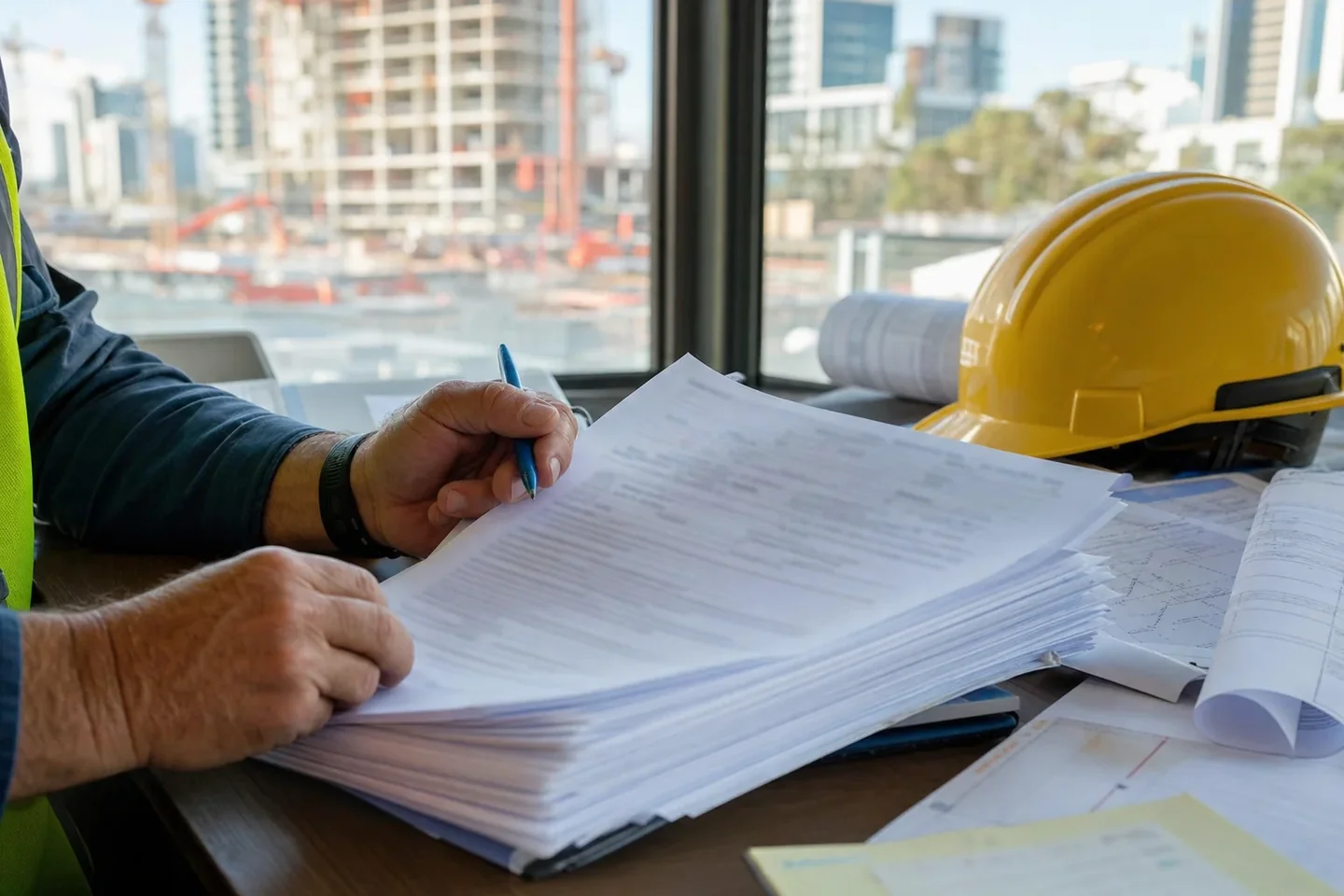
Sub-Contract Reviews Perth
We read the fifty-page commercial subcontract you have been handed, flag the clauses that put you at risk and the scope the pricing never allowed for, before you sign. Perth builders and subcontractors.
- 18+ years experience
- First estimate free
- 24hr turnaround
- No lock-in contract
The Contract Is Written in the Builder's Favour
A commercial subcontract is not written to protect you. It is drafted by the head contractor's lawyers to shift as much risk as possible down the chain onto the subbie who signs it.
These agreements run to fifty pages or more, and the clauses that hurt you are buried in language most tradies never get time to read properly. You are on the tools all day and the contract lands in your inbox with a Friday deadline to sign.
We read the whole thing, flag the parts that put your money and your business at risk, and point out the scope the pricing quietly assumes you will do for free. We are estimators, not lawyers, so for the legal wording you still use a solicitor. What we give you is a plain-English picture of what you are actually signing up for.

What We Check in a Subcontract
The dollar figure at the front of a subcontract is the part everyone reads. The clauses that decide whether you keep that money are further back, and they are where a job goes from profitable to painful.
| Clause Area | What We Flag | Why It Matters to a Subbie |
|---|---|---|
| Scope of works | Vague wording, 'all works reasonably required', undocumented inclusions | This is how unpaid scope creeps in. If it is not priced, it should not be in scope. |
| Payment terms | Long payment periods, pay-when-paid clauses, retention amounts | A 45-day payment term on thin margins can sink your cash flow before the job is done. |
| Variations | Notice periods, written-instruction requirements, valuation method | Miss the notice period and you do the extra work for nothing. |
| Liquidated damages | Daily damages rate, who owns the program, delay definitions | You can wear a delay caused by someone else if the clause is not carved out. |
| Retention and security | Retention percentage, release milestones, bank guarantee demands | Money held for months after you finish, sometimes never released without a fight. |
| Defects liability | Length of the period, what counts as a defect, call-back obligations | A long or vague defects period keeps you on the hook well after practical completion. |

Pay-When-Paid Is the One That Catches Subbies Out
A pay-when-paid or pay-if-paid clause means you only get paid once the head contractor gets paid by the principal, which can be never if the job goes bad above you. In Western Australia the Security of Payment Act limits how far these clauses can go, but plenty of subcontracts still try it on. If we see one, you hear about it before you sign.
Nobody Reads Page Forty
A commercial subcontract can run past fifty pages. The price and the scope are at the front, which is the part everyone reads before signing.
The clauses that decide whether you get paid on time, who wears a delay and what happens when the head contractor changes the drawings are much further in.
The Clauses We Always Flag
- Payment terms and how claim dates are actually counted
- Pay when paid style wording that is not enforceable but still bites
- Retention amounts and when release is triggered
- Time bars on variation and delay notices
- Liquidated damages and how they are calculated
- Scope by reference to documents you have never seen
- Insurance and indemnity obligations that sit above your cover
- Suspension, set off and termination for convenience

50+
Pages in a typical set
Commercial subcontracts
Days
Time bars identified
Notice periods marked up
24hr
Usual turnaround
Standard subcontracts
Free
First job
No lock-in contract
Sign It Once, Live With It All Job
A subcontract is the only document that governs the whole job. Once it is signed, every disagreement that follows is settled by what is written in it, not by what was said on site.
An hour spent reading it properly is the cheapest hour in the entire project. It is also the only hour where you still have leverage, because before you sign you can still ask for a change.
We are not lawyers and we do not pretend to be. What we do is tell you, in plain language, what the commercial risk in front of you actually is.
Scope Gaps Are Where the Money Leaks
The most expensive part of a bad subcontract is rarely a single nasty clause. It is the gap between what you priced and what the contract quietly expects you to deliver.
The Scope Traps We See Most Often
- Set-out, survey or engineering that the contract makes your responsibility but you assumed was the builder's
- Temporary works, propping, edge protection or traffic management priced by nobody and expected of everybody
- Cleaning, waste removal and skip costs bundled into your rate without a line for it
- Attendance on other trades, standing time and re-work caused by the program, not by you
- Provisional sums and prime cost items that carry more scope than the allowance covers
- Compliance documents, test certificates and handover paperwork that take real hours to produce
A subbie does not lose money on the work they quoted. They lose it on the work the contract assumed they would throw in for free.
We cross-check the subcontract scope against your actual takeoff and price. Where the contract asks for something the price never covered, we tell you, so you can either claim it, price it as a variation or push back before you sign.
How a Sub-Contract Review Works
You send us the contract and your pricing. We read both, mark up the risks and hand you a clear summary. Most reviews come back inside a couple of days, faster if a signing deadline is on you.
- 01
Send Us the Contract and Your Price
Email the full subcontract, any attached schedules and the price or takeoff you submitted. The more we have, the more we can catch.
- 02
We Read the Whole Agreement
Every page, not just the front sheet. We work through scope, payment, variations, damages, retention and defects clause by clause.
- 03
We Cross-Check Scope Against Your Price
We compare what the contract expects against what you actually priced, and flag every gap where unpaid scope is hiding.
- 04
You Get a Plain-English Summary
A written markup listing the clauses that put you at risk and the scope you have not been paid for, ranked by how much it could cost you.
- 05
You Decide Before You Sign
Push back on the clauses, price the gaps as variations, or walk away from a job that was never going to pay. You go in with your eyes open.
50+
Pages Read
Every clause, not just the front sheet
WA
SOP Act 2021
Payment protection flagged
2 Days
Typical Turnaround
Faster on a deadline
Free
First Review
Test us before you commit
Where a Review Ends and a Lawyer Starts
We are honest about what a sub-contract review is and is not. We spend our days in construction contracts and we know where subbies get stung, so we can tell you what a clause means for your margin and your risk in plain terms.

We Are Estimators, Not Solicitors
A sub-contract review tells you what the contract asks of you commercially and where the money risk sits. It is not legal advice and it does not replace a solicitor. If a clause needs to be legally challenged, redrafted or enforced, that is a job for a construction lawyer, and we will tell you when you have reached that point.
For most jobs, the review is enough to negotiate a fairer deal or price the risk properly. For the ones that are not, you at least know exactly which clause to hand your lawyer, instead of paying them to read all fifty pages from scratch.
Common Questions
Straight answers on how we price sub-contract reviews in Perth. If yours is not here, send your plans and just ask.
No. A sub-contract review is a commercial and scope check, not legal advice. We tell you what a clause means for your money, your cash flow and your risk in plain English, and we flag the scope you have not been paid for. If a clause needs to be legally challenged or redrafted, that is a job for a construction solicitor and we will tell you when you have hit that point.
Most commercial subcontracts are turned around within a couple of business days. If you have a signing deadline breathing down your neck, tell us when you send it and we will do our best to fast-track it. A fifty-page agreement takes time to read properly, and rushing it defeats the purpose.
Send the full subcontract with every schedule and annexure attached, plus the price or takeoff you submitted for the job. Having your pricing lets us cross-check the contract scope against what you actually allowed for, which is where most of the value is. If you only have part of the contract, send what you have and we will tell you what is missing.
Yes, and sometimes that is the smarter order. Reviewing the contract first means you can build the risky clauses and the hidden scope into your price rather than discovering them after you have already committed to a number. If the tender timeline allows it, send the contract early.
No. We review commercial subcontracts for concreters, bricklayers, plasterers, tilers and other Perth subbies and small builders. The trade changes the scope detail, but the contract traps, payment terms, variations, damages, retention, defects, are much the same across trades.
Related Services
Other estimating services that often go alongside Sub-Contract Reviews.

Tender and Bid Estimating
End-to-end tender pricing support, from reviewing documents and querying discrepancies through to final submission
View Service
Progress Claims and Variations
Accurate progress claims and variation pricing prepared against the contract to protect your margin
View Service
Quantity Takeoff and Bill of Quantities
Full colour-coded plan markup with legend plus a structured BoQ spreadsheet ready to send to subbies
View Service
Concrete Estimating
Residential slabs, driveways, footpaths and footings, quantities and labour priced on real Perth rates
View Service
Get Your First Estimate Free
Send us your plans and we will take it from there. First job is on us, 24-hour turnaround on most residential jobs, and no lock-in contract.