AI Overview
Perth construction costs differ from eastern states due to isolated supply chains, WA-specific labour rates and local council requirements that national rate cards do not capture. Concrete, steel and trade labour are all priced differently in WA, with supply isolation and freight costs creating a permanent gap between Perth and Sydney or Melbourne rates. An estimate built on east-coast pricing will consistently miss on Perth jobs.
Key Highlights
- Perth concrete supply prices are set by WA suppliers and do not follow eastern states movements closely
- Subcontractor labour rates in WA have their own market - national award rates are a floor, not a reality
- Council setback and crossover requirements in Perth are specific to each local government area
- Freight costs for imported materials add a line item eastern states estimating does not include
- Soil conditions in Perth are regionally specific and affect slab design in ways a national estimator will miss
- A Perth estimator working from current WA supplier prices will be more accurate than a national service using a 6-month-old rate card
Perth Is an Isolated Construction Market
Perth sits 2,700 km from Melbourne and 2,800 km from Sydney. That distance is not just geography - it means Perth's construction supply chain operates largely independently of the east coast. Concrete, steel, bricks, tiles and most structural materials are either produced locally or freighted in under separate supply agreements.
When Sydney concrete prices move because a major supplier adjusts its pricing, Perth prices move according to WA supplier decisions - Cockburn Cement, Boral WA and the local Holcim operation all set their own schedules. The two markets do not necessarily move together.

Why This Matters for an Estimate
A national estimating service typically maintains a single rate card updated quarterly, sometimes less frequently. When Perth supply prices have moved and the national rate card has not, the concrete volume on your estimate is still right but the dollar figure attached to it is not. On a 200 m3 commercial pour, a 10 percent supply price miss is a significant variation.
2,700km
Perth to Melbourne
Supply chain isolation
15-25%
Typical rate card miss
WA vs east coast on key items
18+
Years in WA construction
Current WA rates applied weekly
Weekly
Rate card updates
Perth supplier pricing checked
Concrete Supply Prices in Perth
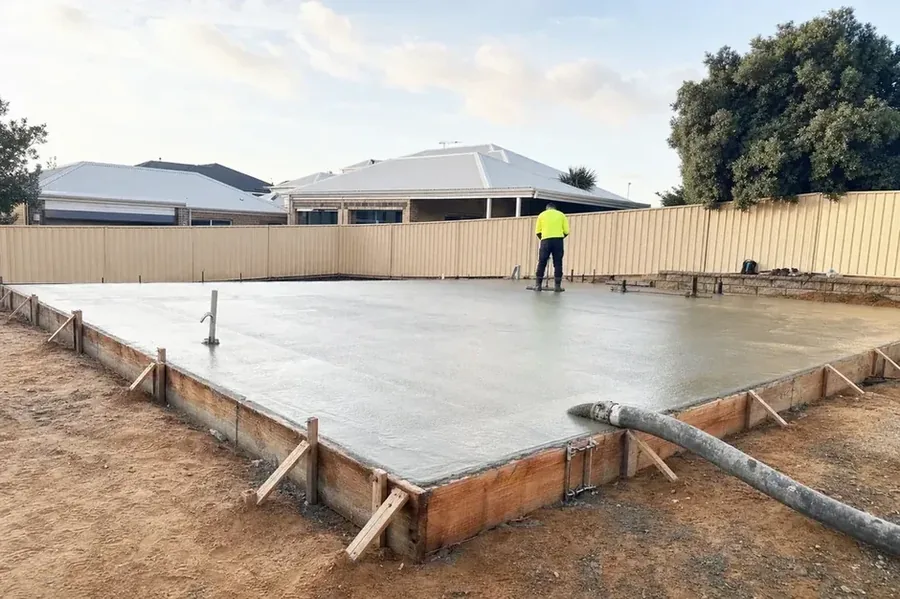
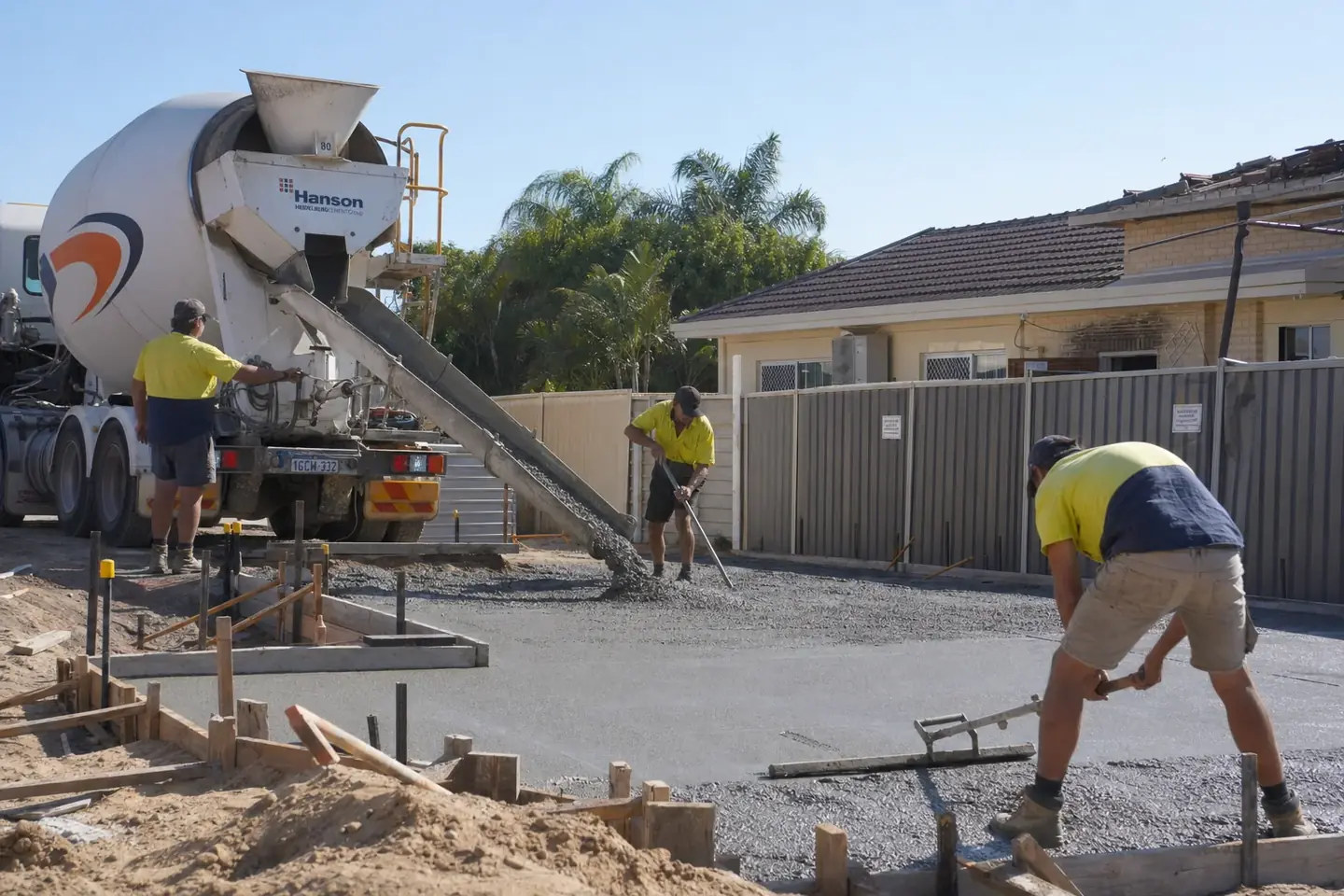
Ready-mix concrete in Perth is supplied by a small number of major players operating local batch plants. The pricing structure - minimum loads, truck cycle times, Saturday and Sunday surcharges, standby fees - is specific to each supplier and changes through the year.
National estimating tools often use a state average or a capital-city benchmark. That number may be close to actual Perth pricing or it may be significantly off, depending on when the rate card was last updated and whether the tool distinguishes between Perth metro and regional WA.
What Gets Missed on the Supply Side
- Saturday and Sunday pour surcharges - Perth suppliers apply these at different rates to eastern states norms
- Small-load fees - a partial load charge applies below the minimum truck capacity, which varies by supplier
- Standby time - charged when the agitator is waiting on site, often at 15-minute intervals
- Pump hire - not all Perth suppliers include pump as a combined service; some require separate hire
- Admixture costs - high-strength or special mix specifications carry different add-on costs in WA
This is the bit a national service cannot fake. We know the going rates for concrete supply, for pumps, for reinforcement, right here in Perth. You tell us what you pay your blokes, we apply your labour rate, and the supply side is priced on what things actually cost in WA, not a number pulled from a database.
Labour Rates Are a WA Market
The national award rate for concreters and general construction labour sets a legal minimum. It does not set the market rate. In Perth, subcontractor labour rates reflect local demand, and Perth has run through several periods where labour has been harder to get than it is in other capital cities.
When WA's mining sector is running hard, construction trades compete for workers with higher-paying mine site rosters. That competition pushes Perth subcontractor rates up, often ahead of eastern states equivalents. An estimating service that has not priced a Perth job recently will miss this.
| Trade | WA Market Dynamic | East Coast Rate Card Risk |
|---|---|---|
| Concreters | Demand spikes with both construction and mine-site rosters | Understates labour when WA is running hot |
| Reo fixers | Specialist trade, WA pool is small | National rate may be below current WA market |
| Formwork carpenters | Tight availability in framing-heavy periods | Award minimum does not reflect current site rates |
| Crane and pump operators | Equipment and operator hire priced separately in WA | East coast bundled rates do not translate |
| Earthworks | Sandy Perth soils and local tip fees drive different unit rates | Volume rates miss WA soil and cartage conditions |
Award rates are what you have to pay. Market rates are what you actually have to offer to get someone on your site. In WA, those two numbers have been different for most of the past decade.
Perth Council Requirements Are Not National
Perth has 30 local government areas. Each one has its own crossover requirements, verge reinstatement rules, footpath specifications and development contribution requirements. None of them are identical to each other, and none of them match the standard assumptions built into a national estimating template.
A crossover estimate for a City of Stirling job needs to reflect Stirling's specifications. A job in the City of Swan has different requirements. An estimator working from a national template will either apply a single generic allowance or omit council-specific items entirely.

Verge Reinstatement Is a Real Cost in Perth
Many Perth councils require the contractor to reinstate the verge and footpath after construction access. This is a real cost - temporary crossover installation, removal, and reinstatement to council specification. A national estimate that does not include a WA-specific allowance for this will produce a variation claim on almost every Perth job where council land is involved.
Soil Conditions Change the Job in Perth
Perth's coastal sand profile is one of the things that most consistently catches national estimators out. The sandy soils common across the northern suburbs, coastal areas and parts of the southern corridor behave very differently from the clay and loam profiles typical in Sydney or Melbourne.
AS 2870 site classification determines the slab design, which determines the concrete volume and the reinforcement schedule. Reactive and highly reactive site classifications - common in Perth's eastern suburbs and hills - require deeper footings, more reinforcement and sometimes soil treatment that adds to both the material and labour cost.
- Sandy coastal soils require good compaction and often sand pad installation before the slab is poured
- Reactive clay sites in the eastern suburbs need AS 2870 category S or M slab designs with heavier reo
- Fill sites from recent development require engineered fill reports before a slab spec can be confirmed
- Limestone caprock in some Perth areas changes excavation costs and footing depths
- Groundwater in low-lying areas like Ellenbrook and parts of the Swan Valley affects slab drainage design

What This Means for Your Estimate
When we estimate a Perth concrete job, the geotechnical report sits on the desk next to the plans. Site classification goes into the estimate - not a generic slab-on-ground assumption. A national estimator who has not worked in Perth will not have that reflex, and the resulting estimate will miss on reactive-site jobs.
Frequently Asked Questions
Perth operates a largely separate supply chain from the eastern states, with local concrete suppliers, different labour market conditions influenced by the mining sector, and WA-specific council requirements that national rate cards do not capture. The result is consistent differences in concrete supply pricing, subcontractor labour rates and site-specific costs.
On concrete supply alone, rate card misses of 10 to 20 percent are common when Perth suppliers have moved and the national rate card has not been updated. On labour for specialist trades, the gap can be wider during high-demand periods. Across a full bill of quantities, the cumulative miss can be material - enough to turn a margin into a loss.
Some do, some do not. The clearest test is to ask when the Perth rate card was last updated and whether it distinguishes between Perth metro and regional WA. If the service cannot answer that specifically, it is using a state average or a capital-city proxy that may not reflect current Perth conditions.
The most common misses are Saturday and Sunday concrete pour surcharges, council-specific crossover and verge reinstatement requirements, site classification-driven slab design on reactive clay sites, and labour rates that reflect the WA subcontractor market rather than the national award.
We price Perth construction and concrete work weekly, which means we are in regular contact with local suppliers and subcontractors. When rates change, we know about it quickly. Our estimates reflect the current WA market, not a quarterly update to a national database.
Ready to Price Your Job
Reading about it is one thing. Getting the real numbers off your own plans is another. Send yours through and we will do a proper takeoff for you.
Written by the Perth Construction Estimating Team
Our estimators have 18+ years across commercial and residential construction and price Perth jobs every week. We work off real WA supply and labour rates, not a generic national card, so the numbers hold up on site.
More About Our Estimators