AI Overview
Polished concrete in Perth is priced per square metre, and the finish you want moves the rate as much as the floor size. How deep the grind goes, the condition of the slab underneath, access, edge work and the sealer each change the labour and the product. We confirm the price once we review your plans and spec, because the rate depends on your floor and your finish.
Key Highlights
- Polished concrete is priced per square metre, and the finish spec sets the rate
- Grinding deeper to show more stone takes more machine passes and more diamonds
- An old slab with glue, paint or cracks costs more to prepare than a new pour
- The densifier, a liquid that hardens the surface, and the sealer or coating change both the labour and the product cost
- The price is confirmed once we review your plans and finish spec
How Polished Concrete Is Priced in Perth
Polished concrete is usually quoted per square metre. The rate covers every stage the floor goes through, from preparing the surface to the final coat of sealer. When the stages change, so does the rate.
Two floors the same size can come back at very different prices. The finish you want, the state of the slab and how easy the floor is to work on make most of the difference.

What Decides the Cost of Polished Concrete?
The cost per square metre comes down to six things: how deep the grind goes, the condition of the slab, whether it is new or existing, the floor area and access, the edges and penetrations, and the sealer or coating. We confirm the price once we review your plans and spec.
Grind Level and Aggregate Exposure
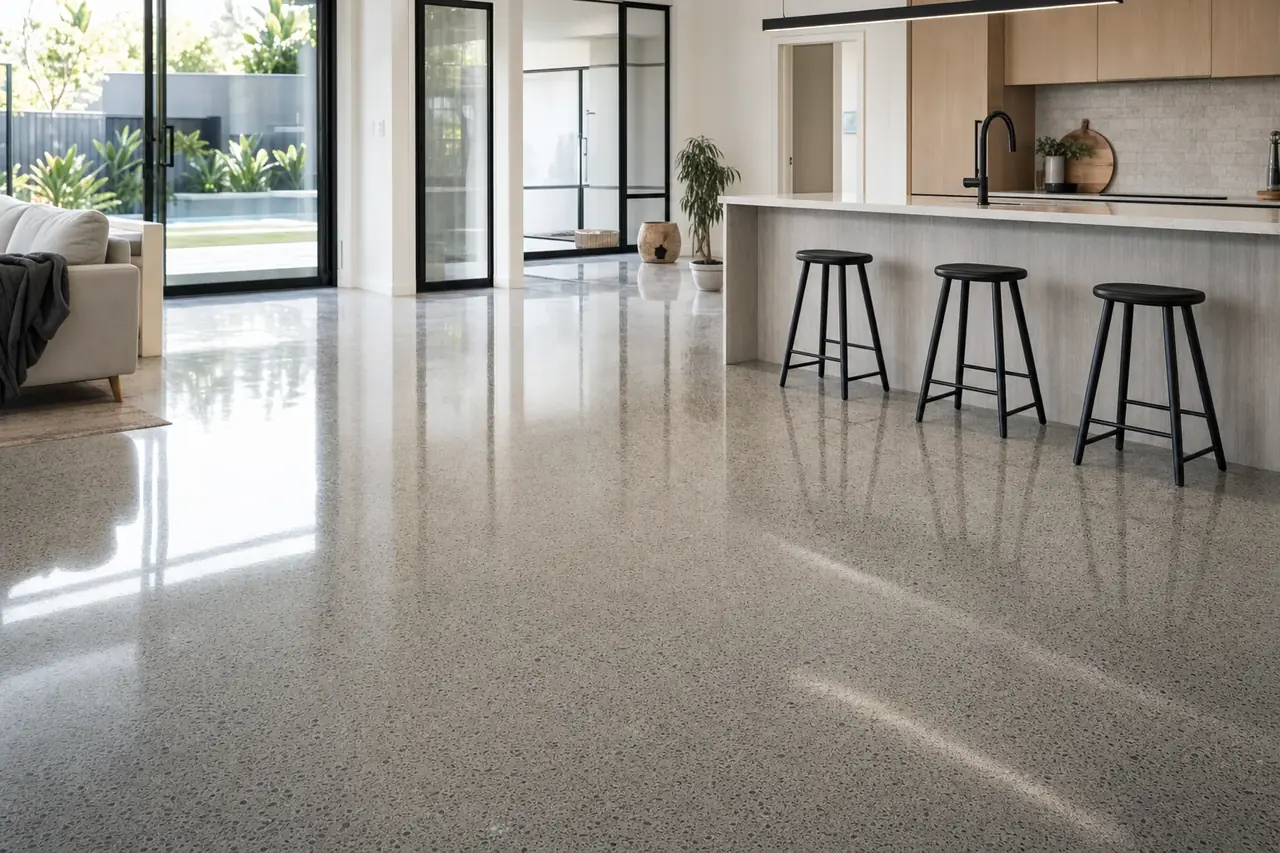
Grinding is done with a machine fitted with diamond tooling, which cuts the top layer off the slab. The aggregate is the stone mixed through the concrete. How much of it you want to see decides how deep the first grind goes.
| Finish | What You See | What It Means for Labour |
|---|---|---|
| Cream finish | Little or no stone, just the smooth top layer of the slab | A light grind and the fewest passes |
| Salt and pepper | Fine sand and small specks of stone | A shallow cut, then the full polishing sequence |
| Full aggregate exposure | Larger stone showing right across the floor | A deep first cut, more passes and more wear on the diamonds |
After the first cut, the floor goes through finer grits, the grades of diamond from coarse to fine, until it reaches your gloss. Gloss is often described in levels from 1, a low-sheen matte, to 4, a high mirror shine. Every extra level means more polishing passes.
A mirror finish over full stone exposure takes the most labour. A light grind with a matte seal takes the least.
Slab Condition and Prep
Prep is everything done to the slab before the grinding starts. On an existing floor that can mean stripping tile glue, paint, old sealer or vinyl adhesive, which wears out diamonds and takes time.
Cracks and chips are filled before the polish, and a crack that is still moving will show through any finish. Moisture matters too. A topical sealer, one that sits on the surface as a film, can lift if it goes over a damp slab.
New Slab or Existing Floor
| What Changes | New Slab | Existing Floor |
|---|---|---|
| Prep | Light, because the surface is clean and known | Coatings, glue and contamination stripped first |
| Repairs | Rare | Cracks and patches priced before the polish starts |
| Moisture | Managed while the slab cures, the days it spends gaining strength | Tested before any sealer or coating goes on |
| How the price is set | From the plans and spec | Often needs photos or a site look before a firm price |
With an existing floor, nobody knows what is under the carpet or tiles until they come up. Photos of the current floor help us flag anything that may need a site look before the price is firm.
Area, Access and Layout
Large open floors cost the least per square metre, because a big grinder can run long, straight passes. Small rooms, hallways and wardrobes mean more setting up, more moving gear and more hand work.
Access counts as well. A ground floor with a wide door and power close by is quick to work on. An upstairs floor where the gear is carried in takes longer, and so does a site where the grinder waits on other trades.
Edges, Corners and Penetrations
A big grinder cannot reach right into a wall, so edges and corners are done with smaller hand grinders. That work is slow, so a floor with a lot of wall length for its size costs more per square metre.
Penetrations are anything that comes up through the slab, like plumbing pipes, floor wastes and columns. Each one has to be worked around by hand.
Control joints are the saw cuts that let a slab crack in a straight line. They are often filled with epoxy or polyurea, a two-part filler that sets hard in the cut. Joint filling is priced by the linear metre.
Densifier, Sealer and Coatings
A densifier is a liquid chemical that soaks in and hardens the surface. It helps the floor take a polish and stand up to wear, and most floors get one partway through the grind.
- Penetrating sealer: soaks into the concrete and leaves a natural look, often used on warehouse floors
- Topical sealer: forms a film on top that gives more sheen, then wears and needs recoating over time
- Epoxy coating: a two-part resin laid as a primer, build coats and a topcoat, each priced on its own
- Metallic epoxy: a decorative epoxy with metal pigment, which means more product and more coats again

Ask What Finish a Rate Covers
If someone quotes a rate per square metre without asking about the finish, ask which grind level, gloss level and sealer it covers. Otherwise you may be comparing a matte warehouse seal with a high-gloss stone finish. The gap then turns up as a variation, an extra charge for work outside the original price.
How We Price Your Polished Floor
- 01
Plans and Spec In
Send the floor plans with dimensions and the finish schedule, the document that lists the finish for each area. With no spec, we price the most common Perth finish for that use and note the assumption.
- 02
Area Measured by Zone
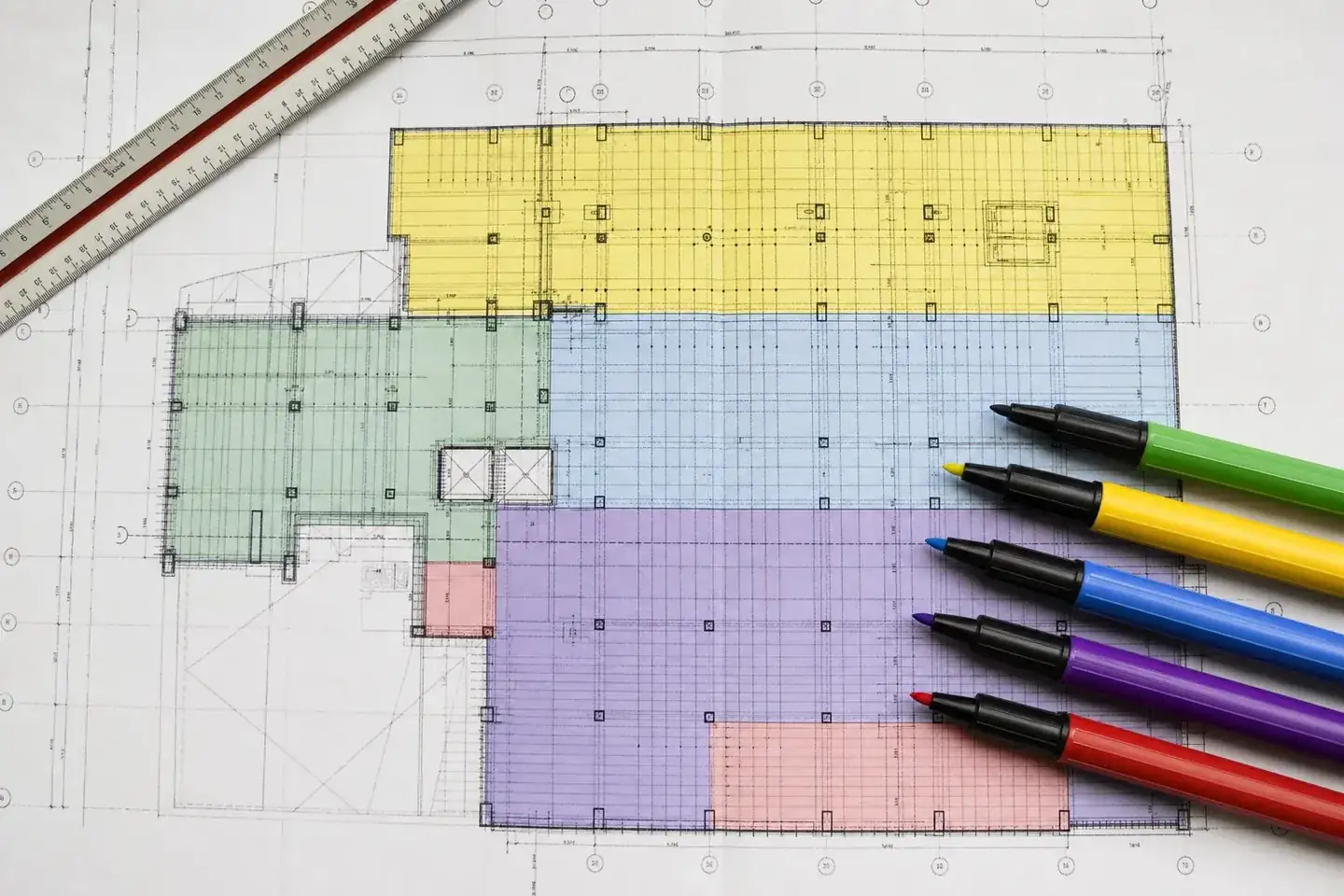
We measure the floor area from the plans and split it wherever different areas get a different finish.
- 03
Each Stage Priced
Prep, the grind sequence, densifier and sealer are each priced on their own line, so nothing is buried in one rate.
- 04
Products Costed
Diamonds, densifiers and sealers are costed at current Perth supply prices for the coverage your floor needs.
- 05
Estimate Back to You
You get a priced breakdown by zone and finish to hand to a client or put in a tender. Most residential floors are back within 24 hours of complete plans and a spec.
Our polished concrete and floor estimating covers decorative and industrial floors, from surface prep to the final seal. We confirm the price once we review your plans, and there is no lock-in contract.
If the slab needs pricing too, concrete estimating covers the slab, footings and reinforcement. The polished finish can sit on the same estimate as its own lines.
Frequently Asked Questions
It depends on the finish, the slab and the site, so we do not quote a flat rate. The grind level, the condition of the slab, the area and access, the edge work and the sealer each move it. Send your plans and spec and we confirm the price once we have reviewed them.
Yes. We price the grinding and polishing labour stage by stage, plus the diamonds, densifiers and sealers, all costed at current Perth supply prices.
Yes. We price epoxy coatings, polyurethane, self-levelling overlays and micro-toppings as well as polished concrete. A micro-topping is a thin cement-based layer laid over an existing slab.
Floor plans with dimensions and the finish schedule. For an existing floor, photos of its current condition help us spot anything that would change the price.
Ready to Price Your Job
Reading about it is one thing. Getting the real numbers off your own plans is another. Send yours through and we will do a proper takeoff for you.
Written by the Perth Construction Estimating Team
Our estimators have 18+ years across commercial and residential construction and price Perth jobs every week. We work off real WA supply and labour rates, not a generic national card, so the numbers hold up on site.
More About Our Estimators